Carbon Footprinting in Accordance With GHG Protocol / ISO 14064
Carbon footprinting according to GHG Protocol / ISO 14064
Particularly for medium-sized enterprises, a reliable greenhouse gas balance is becoming increasingly important – for instance, in the context of customer requirements, bank inquiries, or the development of their own climate targets and transition plans. We support you in establishing your Corporate Carbon Footprint in accordance with the GHG Protocol or ISO 14064, recording emission sources across Scope 1, Scope 2, and relevant Scope 3 categories, and deriving pragmatic measures for your climate strategy.
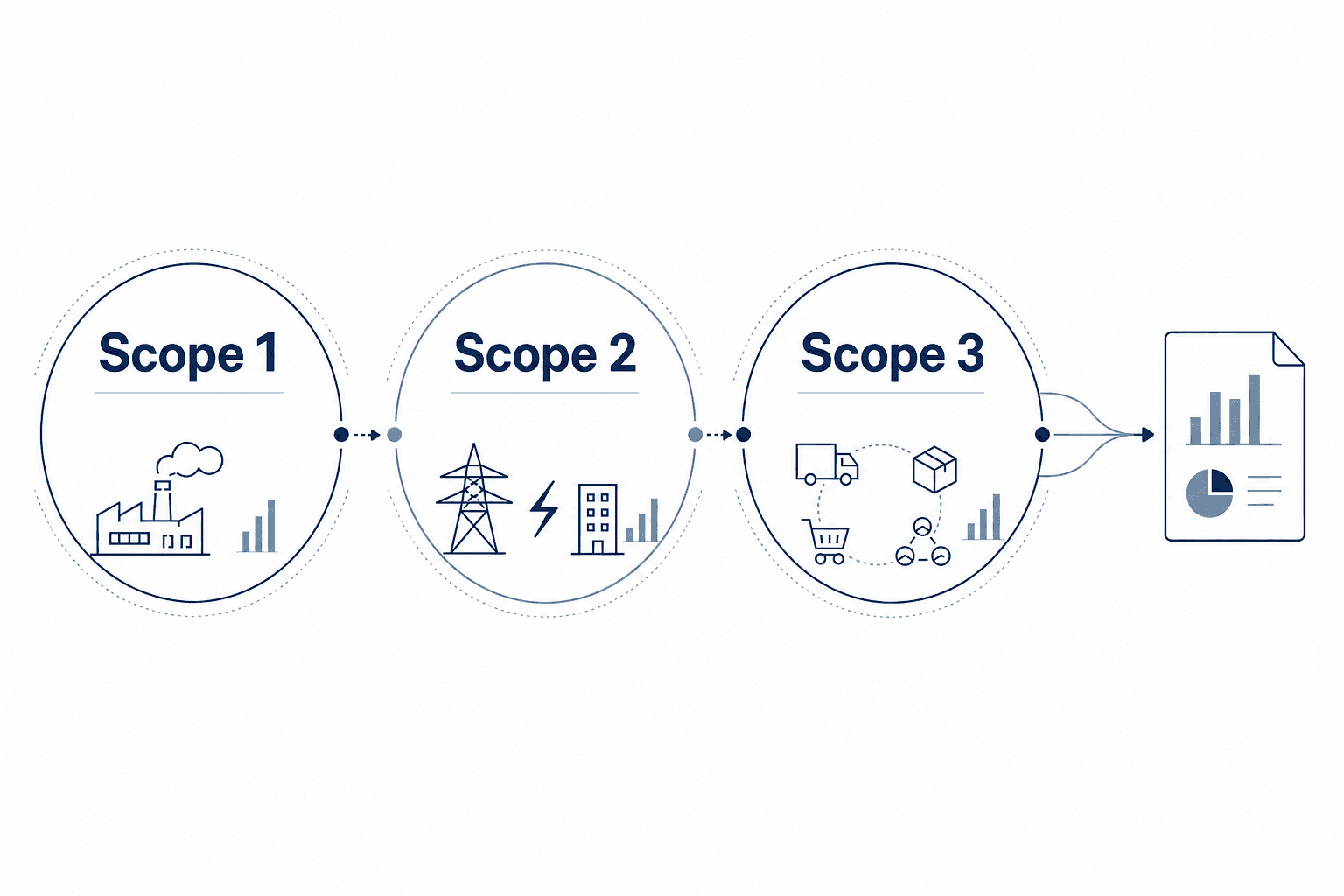
The GHG Protocol and ISO 14064 are the leading standards for accounting and reporting greenhouse gas emissions. They support companies in systematically recording and transparently structuring emissions, and using them as a basis for climate strategies, reduction targets, and sustainability reports.

Our Approach
1. Assessment
1. Assessment
We start with a structured assessment of your existing data, processes, and responsibilities. Together, we analyze which emission sources are already recorded, where data gaps exist, and what requirements arise from customers, standards, or regulatory developments. Based on your current status, we determine which data should be collected and which should be estimated based on plausible assumptions.
In the first step, we get an overview: How do you manage all sustainability aspects? Where does your organization stand in the areas of environment, economy, and social affairs? Which topics are already being addressed – and where are there blind spots? To do this, we record the current status along the ZNU fields of action, identify existing structures, processes, and data, and recognize what is missing for a potential certification.
Result: An overview of your current status, including any remaining gaps and an action plan. Joint assignment of responsibilities.
Typical duration: Several rounds of coordination, usually over 1–2 weeks.
2. Inventory Boundary
Together, we define the inventory boundary for your Corporate Carbon Footprint. This includes organizational and operational boundaries, the classification of Scope 1, Scope 2, and relevant Scope 3 emissions, as well as the selection of suitable data sources and emission factors.
In the first step, we gain an overview: How do you manage all sustainability aspects? Where does your organization stand in the environmental, economic, and social areas? Which topics are already being addressed – and where are there blind spots? To this end, we record the current state along the ZNU fields of action, identify existing structures, processes, and data, and recognize what is missing for a possible certification.
Result: A clearly defined inventory boundary tailored to your requirements and goals that can be efficiently implemented.
Typical duration: Depending on the need for coordination within the company, usually 1–2 weeks.
3. Calculation
3. Calculation
Based on your activity data, we calculate your greenhouse gas emissions. In doing so, we ensure transparent documentation, plausible assumptions, and a sound methodology so that the results are manageable internally and compatible externally.
In the first step, we gain an overview: How do you manage all sustainability aspects? Where does your organization stand in the environmental, economic, and social areas? Which topics are already being addressed – and where are there blind spots? To this end, we record the current state along the ZNU fields of action, identify existing structures, processes, and data, and recognize what is missing for a possible certification.
Result: Corporate Carbon Footprint according to the Greenhouse Gas Protocol or ISO 14064.
Typical duration: Depending on the company’s data resources, typically 4–6 weeks.
4. Review & Climate Strategy
We review the results, identify key emission drivers, and derive concrete recommendations for action. Upon request, we can then support you in developing reduction measures, climate targets, and transparent communication of your progress.
Result: An overview of your key emission drivers and a transformation plan for your climate goals.
Typical duration: Usually 1–2 weeks.
Your contact persons
Would you like to establish your Corporate Carbon Footprint according to the GHG Protocol / ISO 14064 or validate an existing greenhouse gas inventory? Let's talk for 20 minutes about accounting boundaries (Scope 1–3), data baselines, and sensible next steps.
Your contact persons
Would you like to establish your Corporate Carbon Footprint according to the GHG Protocol / ISO 14064 or validate an existing carbon footprint? Let's talk for 20 minutes about the accounting framework (Scope 1–3), data basis, and sensible next steps.
Your Contact Persons
Would you like to establish your Corporate Carbon Footprint according to the GHG Protocol / ISO 14064 or validate an existing greenhouse gas inventory? Let's talk for 20 minutes about accounting boundaries (Scope 1–3), data baselines, and sensible next steps.

